
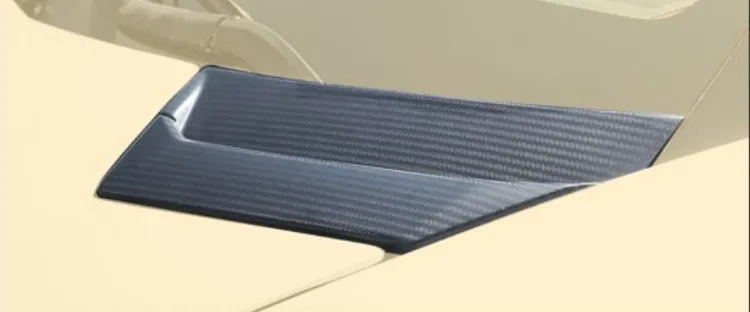
Bonnet air outtake Mansory Carbon for Lamborghini Aventador Competition


Mansory Carbon Bonnet Air Outtake for Lamborghini Aventador Competition
The bonnet air outtake is a vented carbon insert that drops into the upper face of the front bonnet on the Lamborghini Aventador Competition, opening a controlled escape route for air that would otherwise stack up inside the frunk and the front brake-cooling corridor. As soon as the V12 supercar climbs past urban speeds the underside of the nose becomes a high-pressure region; without a properly sized exit, that mass of air recirculates around the radiator pack and bleeds energy off the front axle. This insert resolves the imbalance with a sculpted louvre array shaped to feed the natural low-pressure zone behind the windshield base. It mounts as part of the wider Mansory Carbon Body Kit for Lamborghini Aventador Competition programme and slots equally well onto a stock LP/S/SVJ/Ultimae lid as a standalone retrofit, on coupés and Roadsters alike. With its naturally aspirated 6.5-litre dry-sump V12, scissor-door geometry, ALA-equipped rear deck and aluminium-CFRP monocoque, the Aventador rewards every gram saved on top of the front axle and every honest gram of pressure released ahead of the cabin.
Construction & Materials
The outtake panel is laid from aerospace-grade prepreg carbon and cured under autoclave pressure, the same protocol Mansory uses for show-surface bodywork. The louvre fences are formed in a single shot rather than bonded after the fact, which keeps the leading edges crisp and avoids the fluttering you find on cheaper riveted vents. Internal stiffening webs run perpendicular to the airflow so the slats keep their geometry even when wind speed pushes hard against the underside of the panel.
- Weave: 3K 2x2 twill on the show face, with optional 12K forged-look on request.
- Cure cycle: prepreg autoclave at roughly 6 bar and 130 °C, post-cured for dimensional stability.
- Wall thickness: 1.6 to 2.0 mm across the louvre deck, 2.4 mm at the perimeter flange.
- Mass: approximately 0.85 kg per insert, replacing roughly 1.4 kg of the donor body section it sits inside.
- Hardware: M5 stainless studs with rubber-isolated nut plates plus a structural epoxy bead at the perimeter.
- Finish: UV-stable two-component clear lacquer with HALS additive; satin or gloss, both tinted for warmth on the weave.
- Edge treatment: hand-sanded chamfer along every visible louvre fence, eliminating the printed-look raw edge of cheaper inserts.
- Gaskets: closed-cell EPDM bead on the rear face to keep splash water from finding its way past the louvres into the frunk.
Design & Visual Function
Visually the insert is the punctuation mark on the front bonnet. The Aventador nose is a long, flat plane broken only by the marque shield and the SVJ-era splitter wings; placing exposed twill into the centre of that surface plays directly with the car's existing graphic language. Mansory aligns the weave so the diagonal of the 2x2 twill sits at exactly forty-five degrees to the centreline, which means the carbon shimmers symmetrically when the car is photographed from above. The louvre fences themselves rise on a slight rearward rake, so they read as motion-aft when the car is parked and disappear into a single dark band when the bonnet catches direct sun.
Aerodynamically the panel addresses the stagnation point that forms on the upper bonnet surface as soon as the car runs above roughly 90 km/h. Stock, a meaningful slug of high-pressure air piles up there with no path other than back over the windshield. The outtake bleeds that pressure laterally and downward, which encourages cooler ambient flow to keep moving through the radiator stack. Owners who track the car report a calmer steering rack feel above 200 km/h once the bonnet pressure has somewhere honest to go. For drivers using the front trunk in summer, the same pathway acts as a passive heat purge for the frunk cavity — luggage and detail kits stay markedly cooler after long motorway runs.
The insert is sized to clear the OEM bonnet release latch and the wiper motor casing underneath. It does not touch the ALA 2.0 system on SVJ trim — ALA's variable channels live entirely on the rear deck and central rear wing, so this front-end change is aerodynamically isolated from active aero arbitration. On scissor-door geometry there is no swing-arc interference because the outtake sits well forward of the door cut.
Compatibility & Fitment
The insert is engineered against every Aventador front bonnet variant Mansory has on file: LP700-4, LP750-4 SV, S, SVJ and Ultimae, both coupé and Roadster. Pre-SVJ noses use slightly shallower bonnet flutes than SVJ and Ultimae cars, so the kit is supplied with two perimeter gasket profiles — one for pre-SVJ pressings and one for SVJ/Ultimae pressings. OEM Lamborghini parking sensors, scissor-hinge geometry and oil-cooler intake plumbing are all retained. If a car already wears the matching front bonnet from the Aventador Competition programme, the outtake bolts straight into the moulded aperture; on a stock OEM bonnet a one-off cut is performed using a supplied template.
Installation & Reversibility
Fitment time runs about thirty to forty-five minutes when the host bonnet is already a Mansory carbon bonnet with the cut-out pre-formed. On a stock OEM bonnet, plan ninety minutes to two hours: template, score with masking tape, cut with a pneumatic carbide blade, dress the edges with 320 grit, prime the cut, then bond and bolt. The recommended adhesive is a methacrylate-based structural product compatible with the Aventador's CFRP body chemistry — this is the same family Lamborghini uses for original-equipment panel bonds on the monocoque. Stripping the part later is straightforward on Mansory bonnets; on stock bonnets the cut itself is irreversible, so the bonnet stays modified for life. DIY is realistic for a confident owner who has fit louvres before; for a one-shot install on a six-figure car, a Lamborghini-certified body shop or a Mansory-trained installer is the safer route.
Pairing within the Mansory Aventador Competition programme
The outtake reads strongest when it shares visual logic with the panels around it. The first natural companion is the Mansory Carbon Front Bonnet for the Aventador Competition, whose pre-formed aperture turns this from a retrofit cut into a five-bolt drop-in. The second companion is the Carbon Windshield Wipers Cover, which carries the bonnet weave straight up into the cowl so the eye reads one continuous carbon band from nose to A-pillar. For owners who want the entire frunk surround in matching twill, the Trunk Carbon Cover closes the circle on the front compartment, finishing the inside of the lid in the same lacquered weave that crowns its outer face.
Maintenance & Durability
Lacquered carbon dislikes three things: alkaline cleaners, ammonia-bearing glass sprays, and abrasive sponges. Stay with pH-neutral shampoo, a deep-pile mitt and a microfibre dedicated to carbon panels. A ceramic coating on the outtake is a stronger long-term play than carnauba wax — it builds a sacrificial layer that takes the UV hit instead of the lacquer, and it sheds road film without dulling the twill. Bird droppings and tree sap want immediate attention; both etch lacquer faster than they etch paint. The panel itself sits in the cooler half of the front compartment, so engine-bay heat stress is not an issue here in the way it can be on engine bonnet pieces over the V12. With routine care a properly lacquered insert holds its show-surface gloss for many years; a UV-faded panel can be cut back, refinished and returned to as-new condition by a competent paint shop without disturbing the weave alignment.
Lead Time & Warranty
Mansory builds Aventador Competition carbon to order. Plan four to eight weeks from confirmed specification to dispatch — longer if the order also includes a colour-matched lacquer tint or a forged-carbon upgrade. Each part carries a twelve-month warranty against manufacturing defects covering delamination, lacquer failure under normal use, and dimensional tolerance.
FAQ
Q: Will it fit a pre-SVJ Aventador, or only the SVJ-based Competition cars?
A: It fits every Aventador bonnet from LP700-4 onwards, both coupé and Roadster. The kit ships with two gasket profiles to handle the small flute-depth difference between pre-SVJ and SVJ/Ultimae pressings.
Q: Do I need the matching Mansory front bonnet to install this?
A: No. On a Mansory carbon bonnet it drops in; on a stock OEM bonnet, the supplied template guides a one-time cut and the insert bonds and bolts in place.
Q: How much weight does it actually save?
A: Roughly 0.5 kg over the section of bonnet it replaces. The bigger gain is functional — the louvre array drops nose pressure at speed and lets the front brake-cooling stack breathe.
Q: Will it interfere with ALA 2.0 on an SVJ?
A: No. ALA's flaps and channels are entirely on the rear deck and central rear wing. The bonnet outtake works upstream of any ALA arbitration and is aerodynamically isolated from it.
Q: Raw weave or lacquered — which ages better?
A: Lacquered with a ceramic top coat is the more resilient choice for daily and long-term outdoor parking. Raw weave looks dramatic but needs more frequent decontamination and re-sealing to keep UV haze away.
Pair this outtake with the matching Mansory front bonnet, the windshield wipers cover and the trunk carbon cover for a fully resolved front-compartment treatment. To check stock, confirm gasket profile and lock in a build slot, message the Hodoor desk on WhatsApp +44 7488 818 747 or write to [email protected].