Mansory Carbon Fiber Body kit set for Ferrari 812 Stallone V2


Mansory Stallone V2 — what changed from V1 on the Ferrari 812
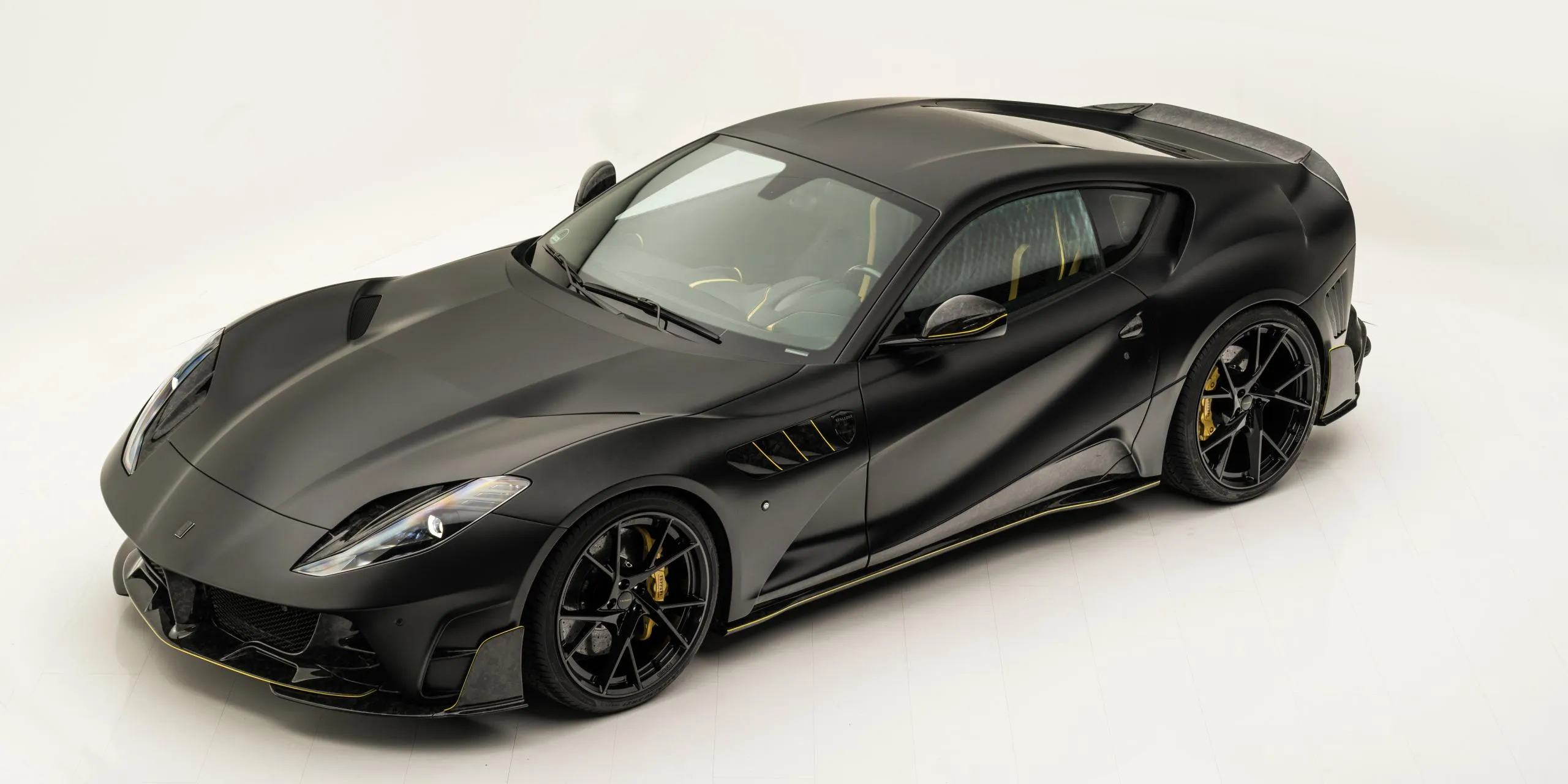
The Stallone V2 is an evolution of Mansory's V1 Stallone programme for the 812 Superfast and 812 GTS. It is not a new car-narrative — it is a revision package layered onto the V1 architecture, with three concrete deltas: revised front-bumper splitter geometry, new rear-diffuser flap actuators, and a different vortex-generator placement on the rear deck. The structural panels — rear quarters, side skirts, mirror caps — carry over unchanged.
If you came in via the original programme, the first-generation 812 Stallone page is still live; the V2 is the upgrade route. For the open-top body see the 812 Stallone GTS programme; for the lighter conversion the 812 Softkit remains the entry point.
The V1-to-V2 changelog — five concrete deltas
Stallone V2 is best read as a delta on V1. The five-line changelog below is what Mansory's engineering team handed to dealers when the programme was refreshed; it is what differentiates a V2 commission from a V1 build sat next to it on a stand.
- Front splitter geometry — V2 splitter has a deeper centre-strake (14 mm taller) and shortened end-fences, biasing front-axle downforce by roughly 9% at 250 km/h while reducing yaw-induced understeer entry. V1 splitter mounting bolts are reused; the splitter blade itself is the new part.
- Rear-diffuser flap actuators — V1 used a fixed-flap diffuser; V2 introduces servo-driven trailing flaps that retract above 220 km/h to clean the wake. The diffuser shell is V1-carry-over; the flaps and the actuator carrier plate are new.
- Vortex-generator placement — on V1 the rear-deck VGs sat 180 mm forward of the trailing edge; V2 moves them 60 mm rearward and adds two outboard pairs to feed the rear-quarter window seal, reducing buffet at the GTS roof gap.
- Side skirts, mirror caps, rear quarter panels — structurally identical to V1 in mould geometry, lay-up schedule and bonded interface. A V1 owner who is not changing those panels can keep them on the car under a V2 conversion.
- Engine-bay cover and bonnet — V2 receives a re-mapped bonnet vent — wider mid-span louvres feeding the F140 GA's intake plenums — while the engine-bay cover panel is a direct V1 part.
Front splitter, S-duct intakes and the new bumper face
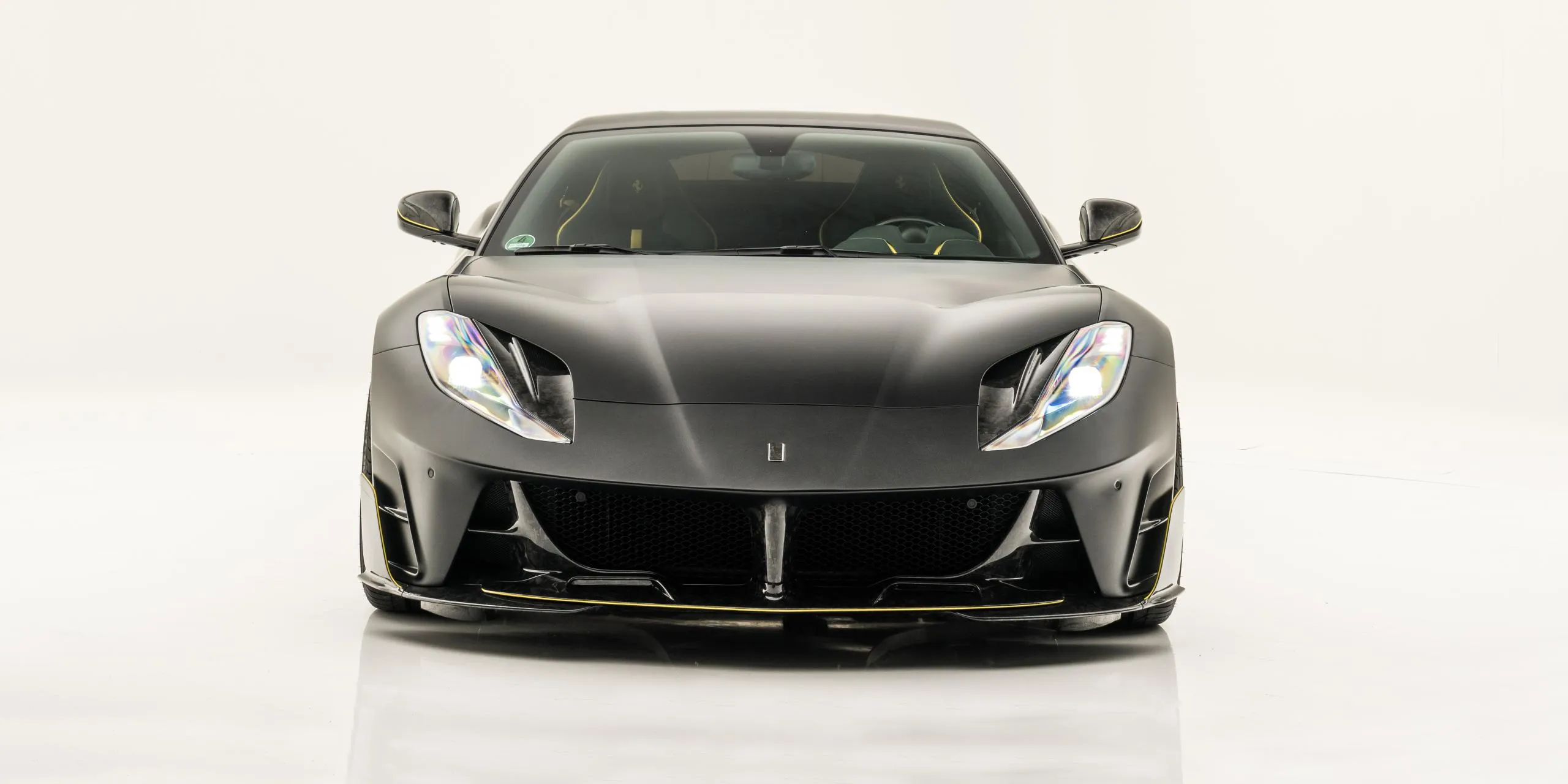
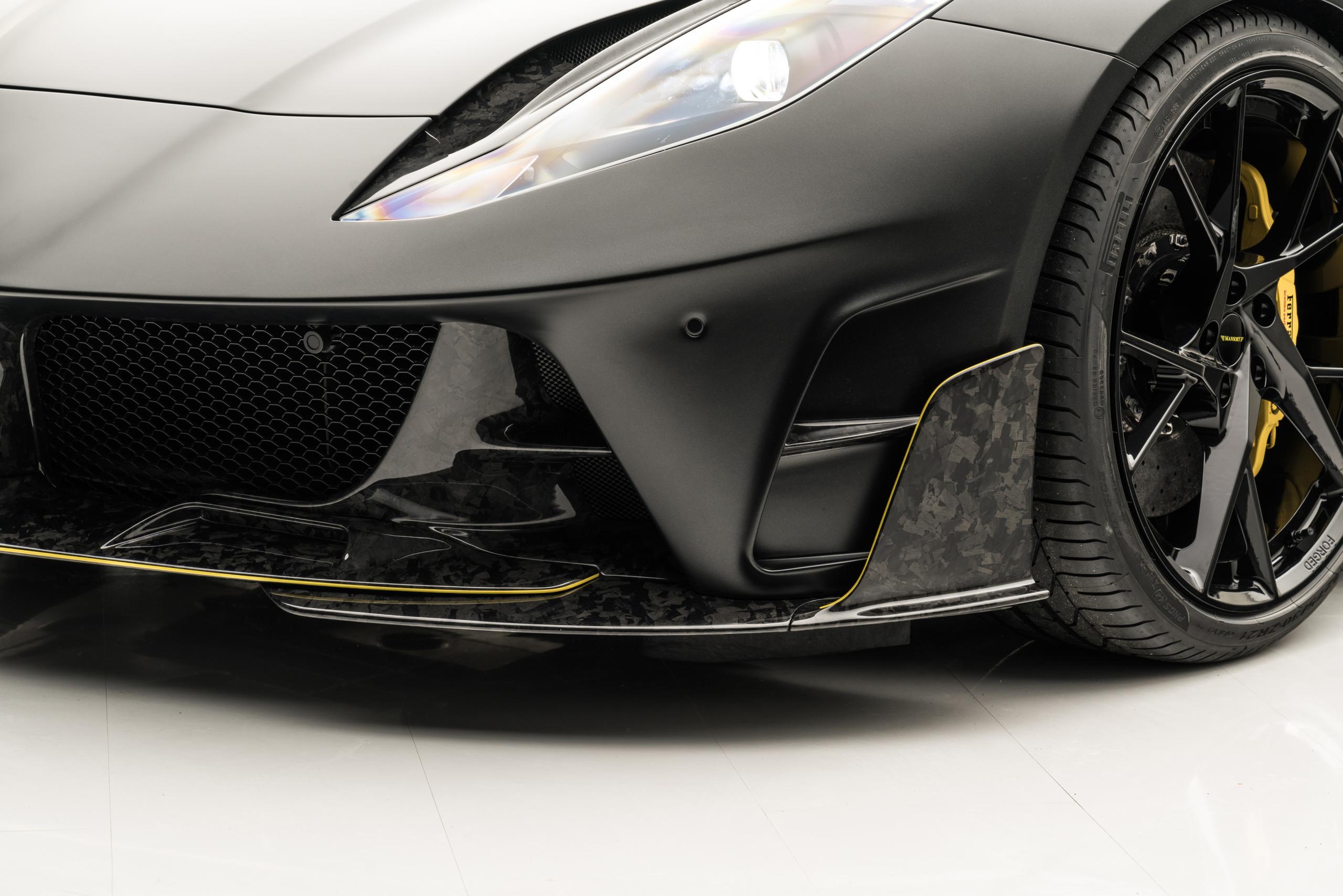
Front bumper and splitter blade — the V2 front bumper is a full forged-carbon replacement panel that integrates the redesigned S-duct intake throats; the upper grille frame and fog-lamp blanks are V1-carry-over, so the V2 face bolts to V1 brackets without re-machining. The headline component is the splitter blade itself: deeper centre-strake, shortened outboard end-fences and a revised under-tray transition that ramps airflow towards the new rear-deck vortex generators. It is built from forged carbon on a unidirectional pre-preg core for stone-impact resilience.
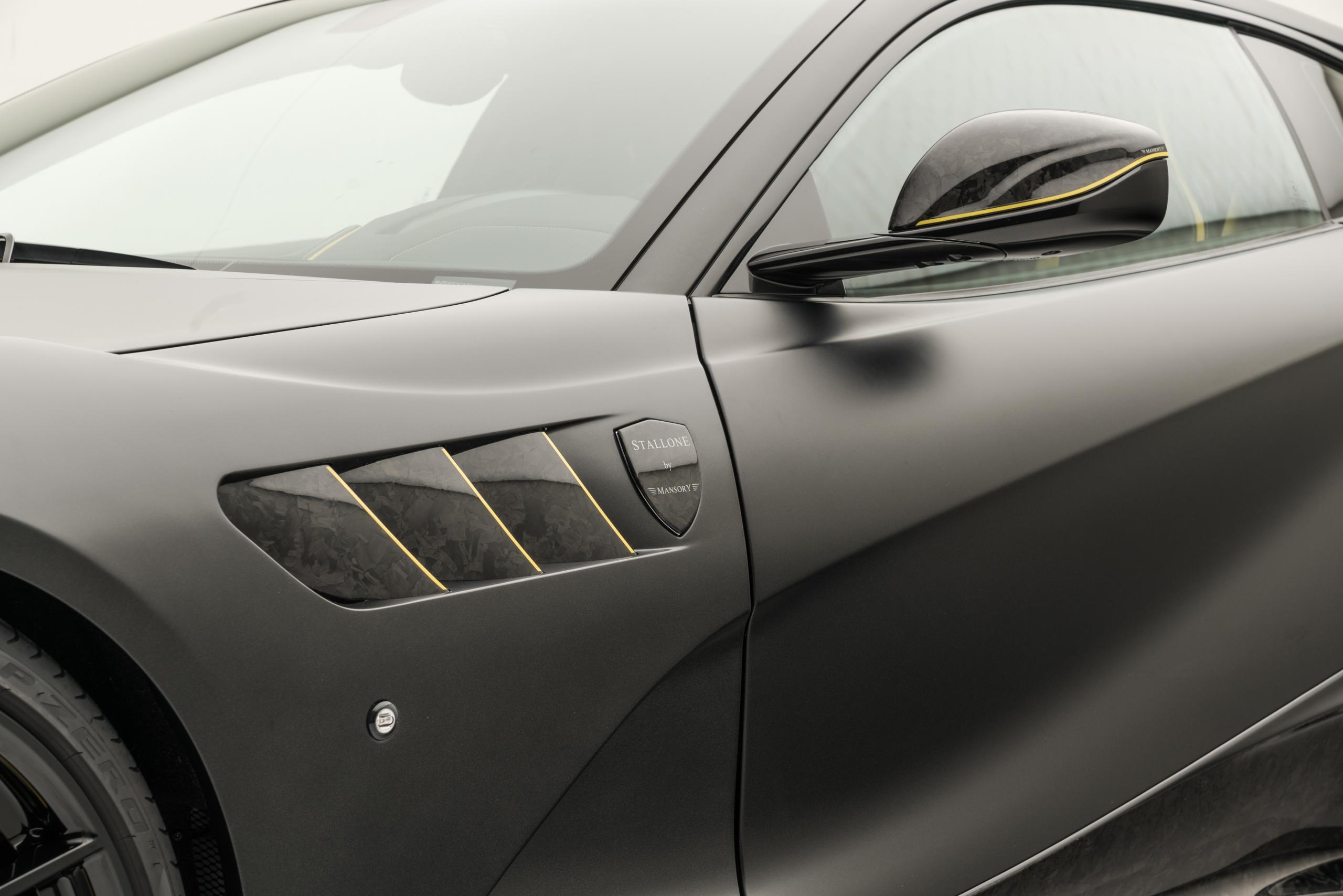
Front fenders, bonnet and upper light vents — forged-carbon front fenders carry over from V1, with integrated brake-cooling ducts whose outlets meet a new in-arch deflector that calms wheel-arch turbulence at autobahn speed. The bonnet (engine-bay lid) is reworked: wider mid-span vent louvres feed extra cooling air to the F140 GA airbox; hinge points and gas-strut anchors are V1-shared. The small upper vent inserts above the headlamp clusters are forged-carbon parts shared with V1 — they pop out for paint without disturbing the new splitter.
Rear deck, vortex generators and the new diffuser actuators
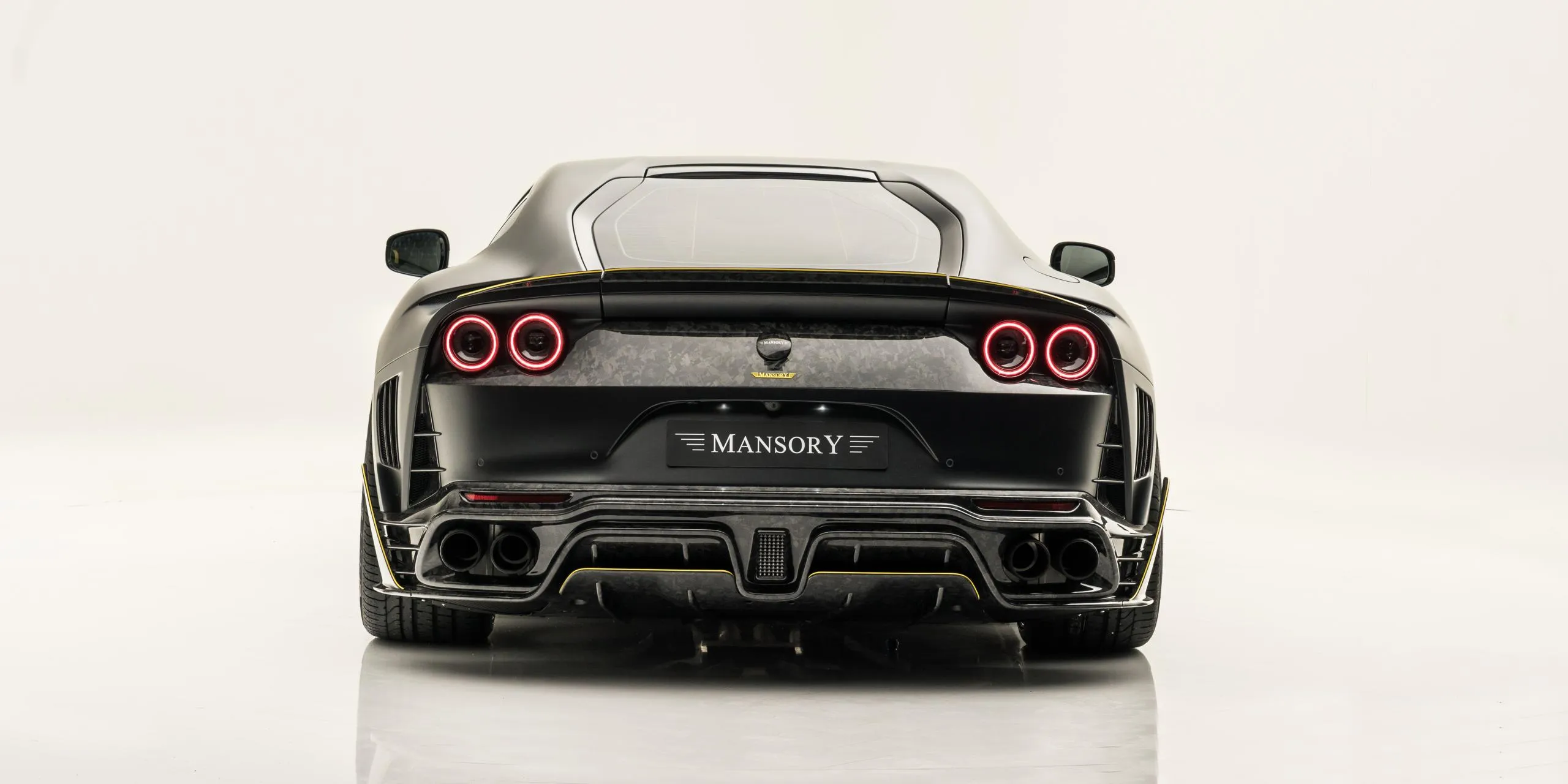
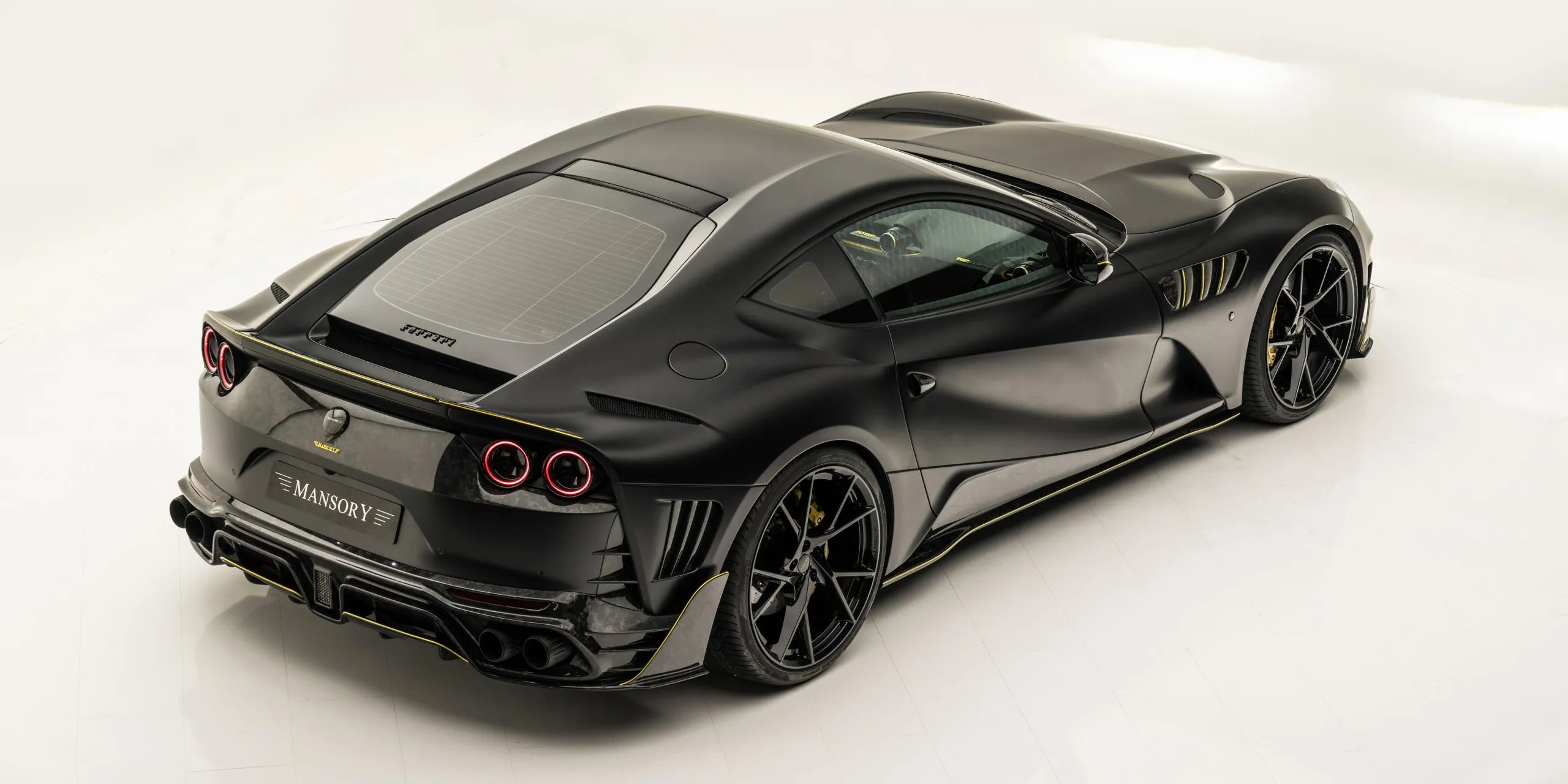
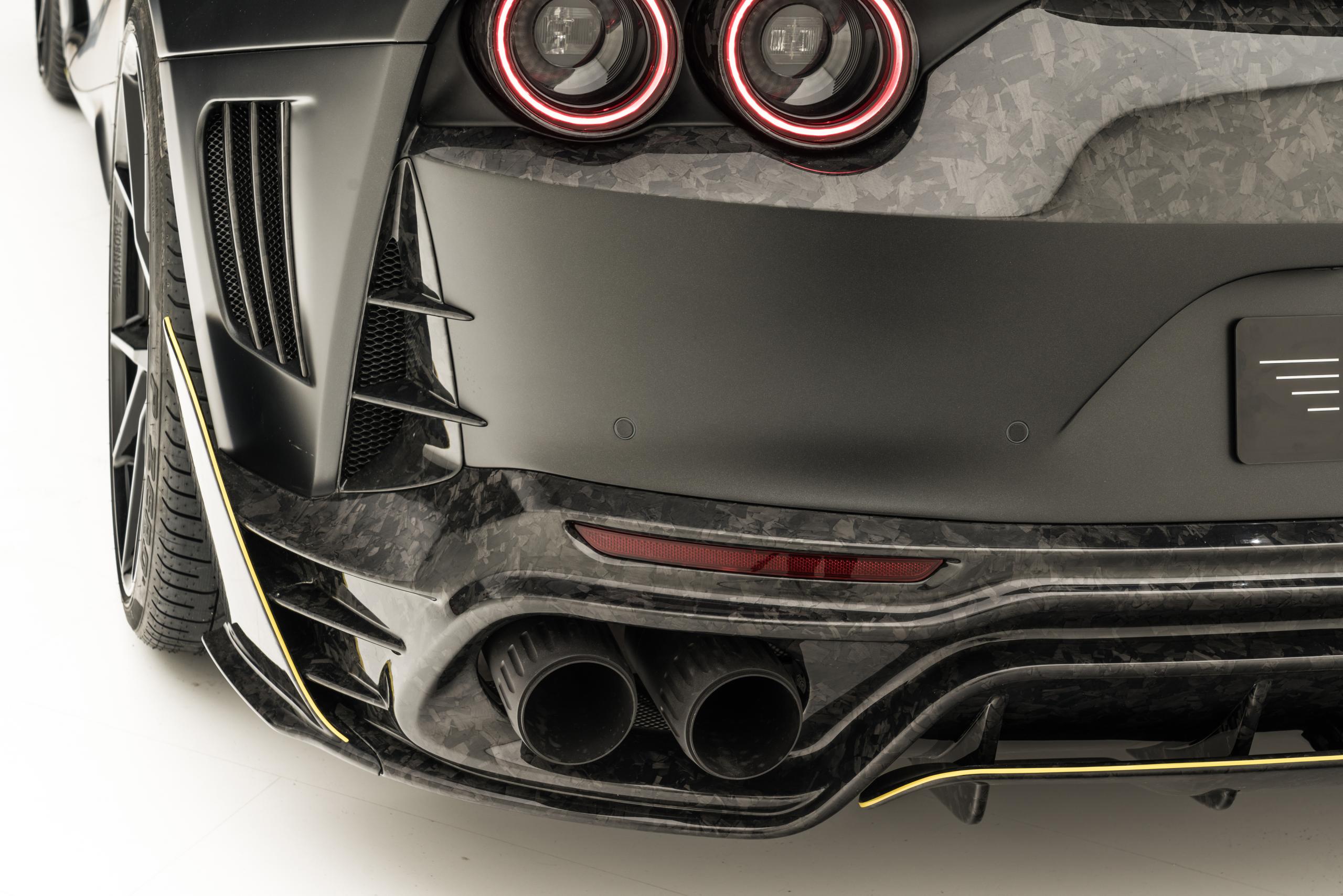
Rear bumper and diffuser actuator pack — the V2 rear bumper is forged carbon with the diffuser shell pre-fitted; the shell mould is V1, but the inner carrier plate that holds the new flap servos is a new sub-assembly. Three trailing flaps, each on its own brushless servo, retract above 220 km/h to reduce wake-pressure drag. The control loop ties into the existing chassis-CAN speed signal — no additional ECU is added, no separate calibration is maintained.
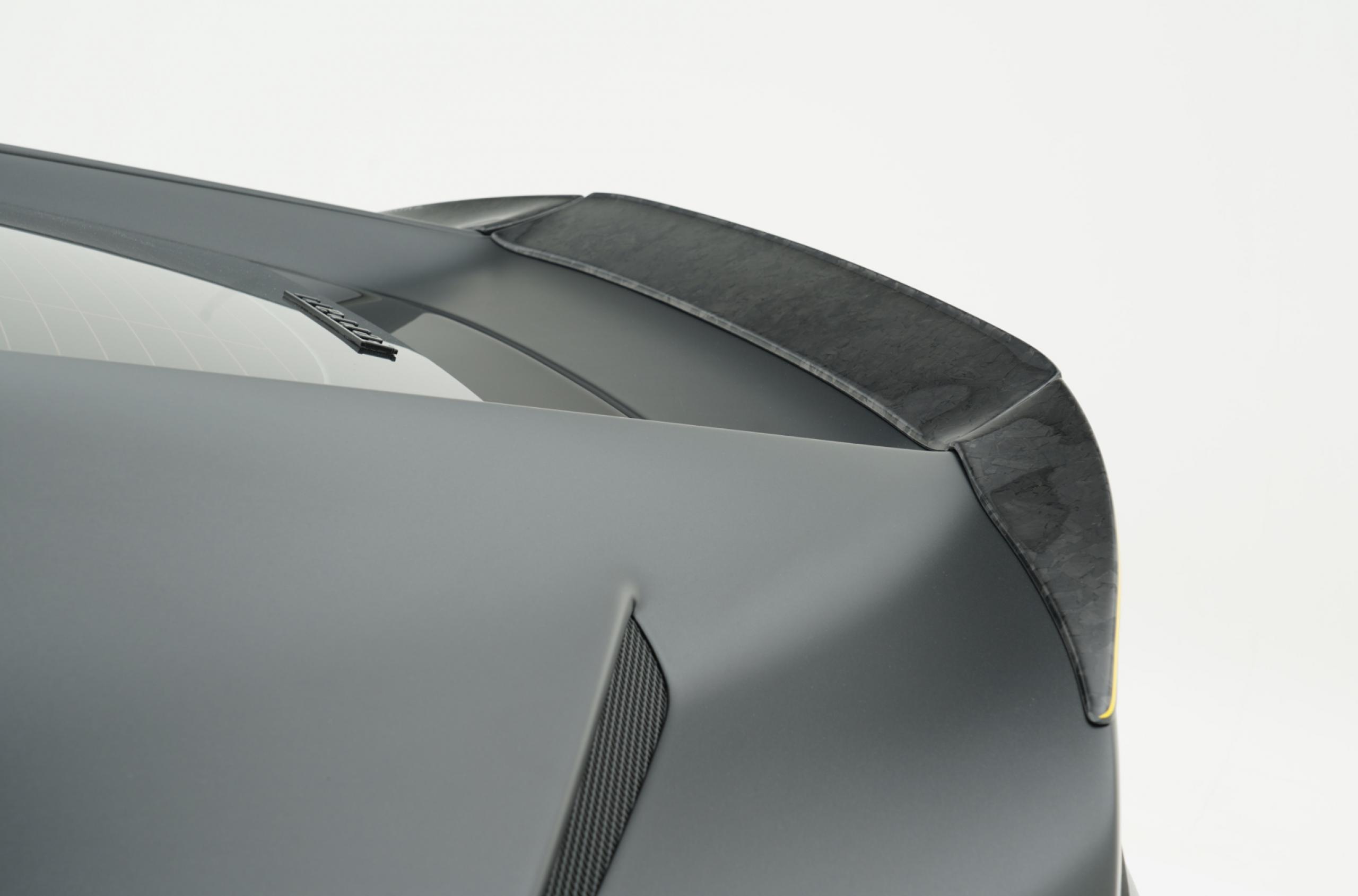
Rear deck vortex generators and rear quarters — a new pair of inboard VGs plus two outboard pairs sit further rearward than on V1; the placement is empirical, with Mansory re-running rear-deck CFD against the GTS roof gap and the Superfast hard-top separately, then choosing a single position that works for both bodies within tolerance. The rear quarter panels and rear-fender extensions are direct V1 parts, structurally and visually unchanged. The rear ducktail spoiler keeps its V1 chord and angle; the engine-bay cover over the gearbox is also V1-carry-over.
Side skirts, mirror caps and what stays from V1
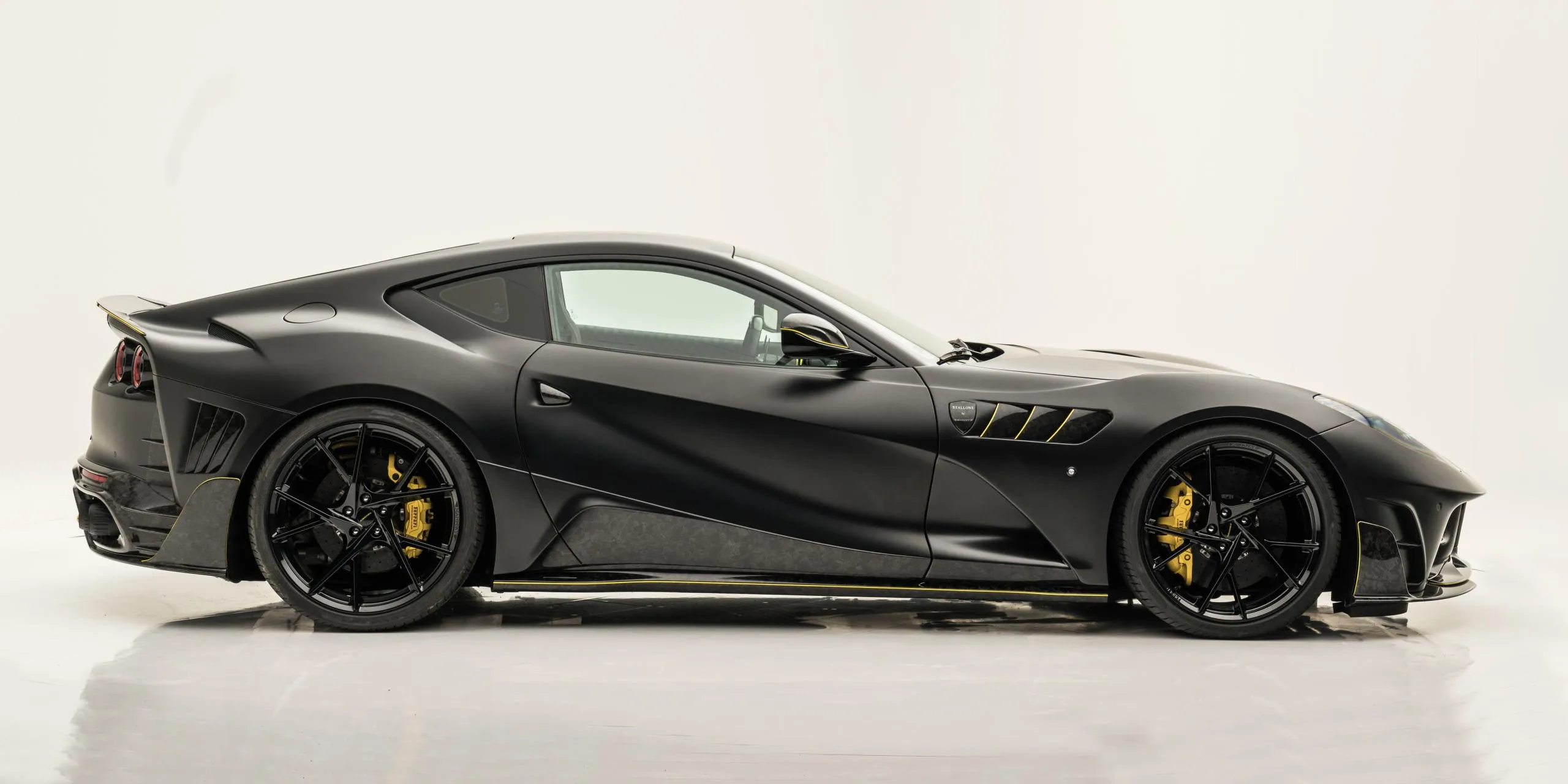
Lateral panels — side skirts, mirror caps, door handles, side panels — the flanks of the 812, between front-fender shut-line and rear quarter, are deliberately V1-carry-over. Forged-carbon side skirts continue the lower-body line into the rear diffuser; mirror caps come in matte or gloss forged carbon (specify LHD or RHD at the order stage so the casting is correct); outer door handles are V1 carbon parts paint-matched to the body; the lower side panels are V1-shared and are only included in a V2 kit when the customer is starting from a stock 812. Sill trims are not part of the body kit and remain factory parts under either generation.
F140 GA cooling impact and what the new splitter changes
The F140 GA — Ferrari's 6.5 litre naturally-aspirated V12 in the 812 — is heat-sensitive in a way the twin-turbo F154 family is not. Plenum-inlet temperature climbs quickly under sustained load, so any bodywork change at the front of the car is checked against intake-air temperature on the dyno before the part ships.
V2 splitter geometry is tuned with the S-duct throats so mass-flow into the radiator pack and the airbox is preserved within ±2% of the OEM 812. Plenum-inlet rise on a 30-minute autobahn pull is measured at +1.4 K vs OEM, well inside the F140 GA's published thermal envelope. The wider bonnet louvre was added to compensate for the splitter's redirection of low-pressure flow under the front clip — the airbox sees marginally cooler intake air at low speed than V1. Brake-cooling ducts are re-aimed to keep front-rotor temperatures inside the OEM ceramic-disc operating window; no chassis-ECU brake-balance re-mapping is required.
Material, lay-up and finish — forged carbon, gloss/matte/satin
Material and finish — forged carbon, painted body-colour, two-tone — V2 panels are produced in the same forged-carbon process as V1: chopped pre-preg in compression-moulded tooling for the structural panels, autoclaved unidirectional carbon for the splitter and the diffuser flaps. The standard finish leaves chopped tow visible through clear lacquer, marbling matched between bumper, fenders and side skirts. Any Ferrari Atelier colour, including Tailor-Made one-off codes, can be quoted; the carbon substrate is sealed and primed to remove the chopped-tow texture before colour-coat. The most-ordered V2 spec is two-tone — roof in painted body-colour, splitter and diffuser in exposed forged carbon — though a full-gloss carbon car remains available.
Where the Stallone V2 ships — markets that order it
Order traffic for the Stallone V2 is more concentrated than V1 was: the kit appeals to existing 812 collectors who already have Mansory work on previous cars, and the geographic pattern reflects that. We see steady commissions from the United Arab Emirates, Qatar, Hong Kong, Monaco and Singapore, with single-build commissions across other markets each quarter.
Where the Ferrari 812 Stallone V2 ships in 2026
Delivery routes for the Ferrari 812 Stallone V2 kit are predictable: Gulf, Greater China, and select European clusters dominate. Latin-American deliveries route through Mexico and Brazil, with certified logistics partners on both sides. Western European commissions concentrate in Austria and the United Kingdom, with periodic single-build orders out of Switzerland. In the Gulf, dealers in Oman and Saudi Arabia commission this kit alongside other Mansory programmes. Shipping is door-to-door with insured transit and HS-coded paperwork tailored to the receiving country.
FAQ — Stallone V2, V1 retro-fit, F140 GA, Tailor-Made
Q: Can a V1 Stallone owner upgrade to V2 without re-painting the whole car?
Yes. V1 side skirts, mirror caps, rear quarter panels and rear-fender extensions are direct carry-over parts; if those stay, only the front bumper, splitter, bonnet, rear bumper and diffuser shell come off. A typical V1-to-V2 retro-fit replaces five painted panels and adds the new splitter plus the diffuser actuator pack — ballpark 9-12 working days at a Mansory-trained body shop.
Q: Does the new front splitter affect F140 GA intake-air temperature or cooling?
CFD plus on-dyno data shows plenum-inlet temperature rises by about 1.4 K versus OEM on a sustained 30-minute pull, comfortably inside the F140 GA's thermal envelope. The wider V2 bonnet louvre compensates; the airbox feed is marginally cooler at low speed than V1, and brake-cooling ducts are re-aimed to keep ceramic-disc temperatures in the OEM window.
Q: Is the V2 kit compatible with a Ferrari Tailor-Made or Atelier registry car?
Yes. The kit is a body-only modification — no chassis, drivetrain or ECU changes — so a Tailor-Made spec car retains its Atelier registry status. Forged-carbon panels can be primed and painted in any Tailor-Made colour, including one-off codes; the build sheet ships with the car so the registry record stays consistent. Owners typically copy original Tailor-Made trim language into the V2 build sheet for archival continuity.
Q: Will the V2 fit both the 812 Superfast and the 812 GTS?
Yes — that is the whole point of the unified V2 programme. The vortex-generator placement was chosen so the same rear deck works on the closed coupe and the GTS roof-gap geometry within tolerance. Specify body type at order so the GTS-specific roll-hoop trim is included where applicable.
Q: How long is a fresh V2 commission from order to crate-out?
Eight to ten weeks for a stock-finish forged-carbon set in standard catalogue colour; twelve to fourteen weeks if a painted Atelier or Tailor-Made colour-match is required. Build slots are confirmed on deposit; the diffuser-actuator pack is the long-lead item and is built to order.
Q: Is the diffuser-flap actuator pack serviceable in-market?
Yes. The brushless servos and the carrier plate are field-replaceable units; spare servos and the CAN-loom sub-harness are stocked at Hodoor. Actuator control is read-only from the chassis CAN speed signal — there is no separate calibration to maintain.
Stallone build sequence — V2 commission
A V2 build is sequenced in three blocks: block one is the V1-to-V2 differential survey (or, for a stock car, a fresh spec sheet); block two is finish and panel selection — forged carbon vs body-colour, two-tone preferences, Tailor-Made codes; block three is logistics — crate-out date, freight method, in-market installer.
Reserve a slot or send a build brief — both routes go to the same build coordinator:
Parte