



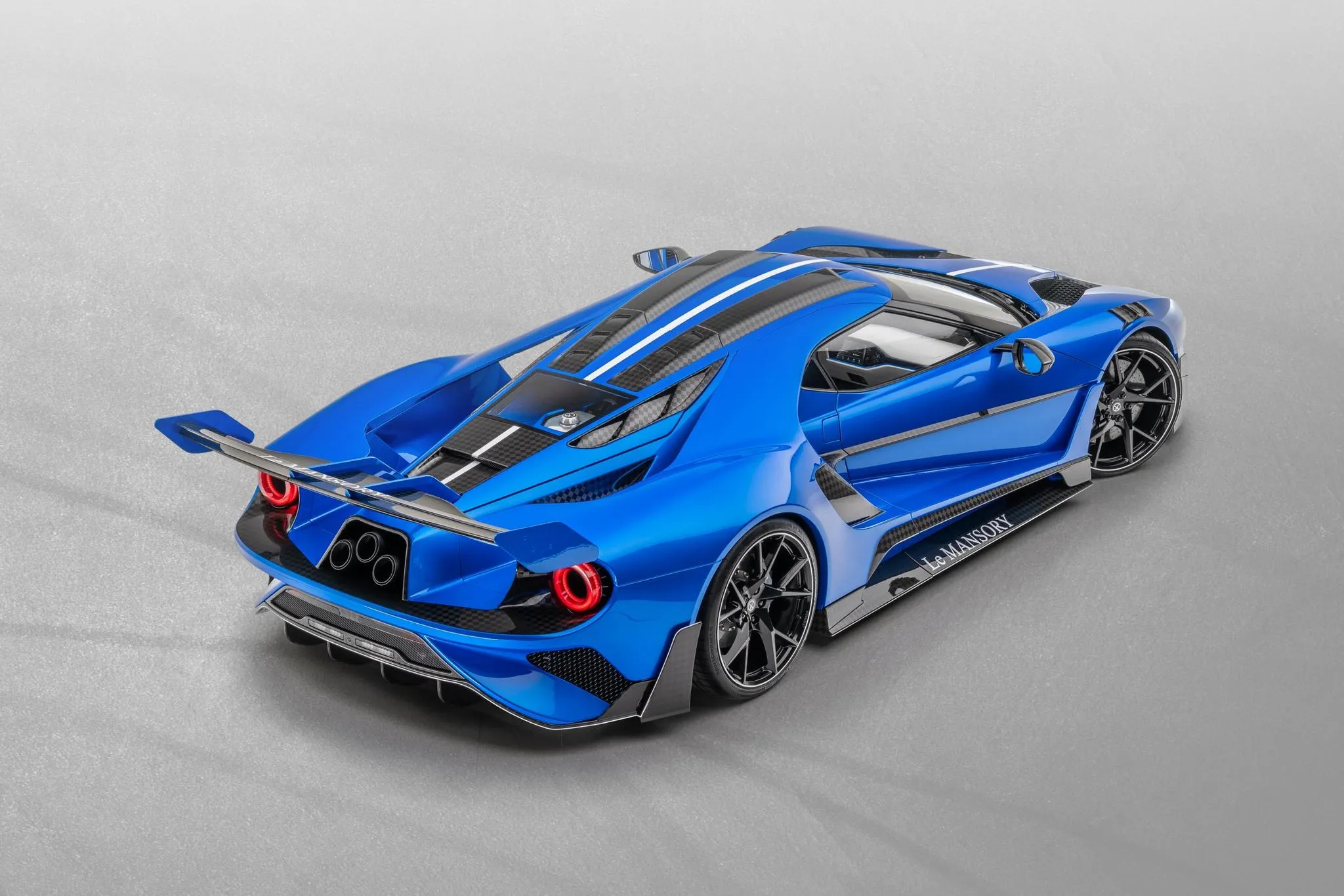

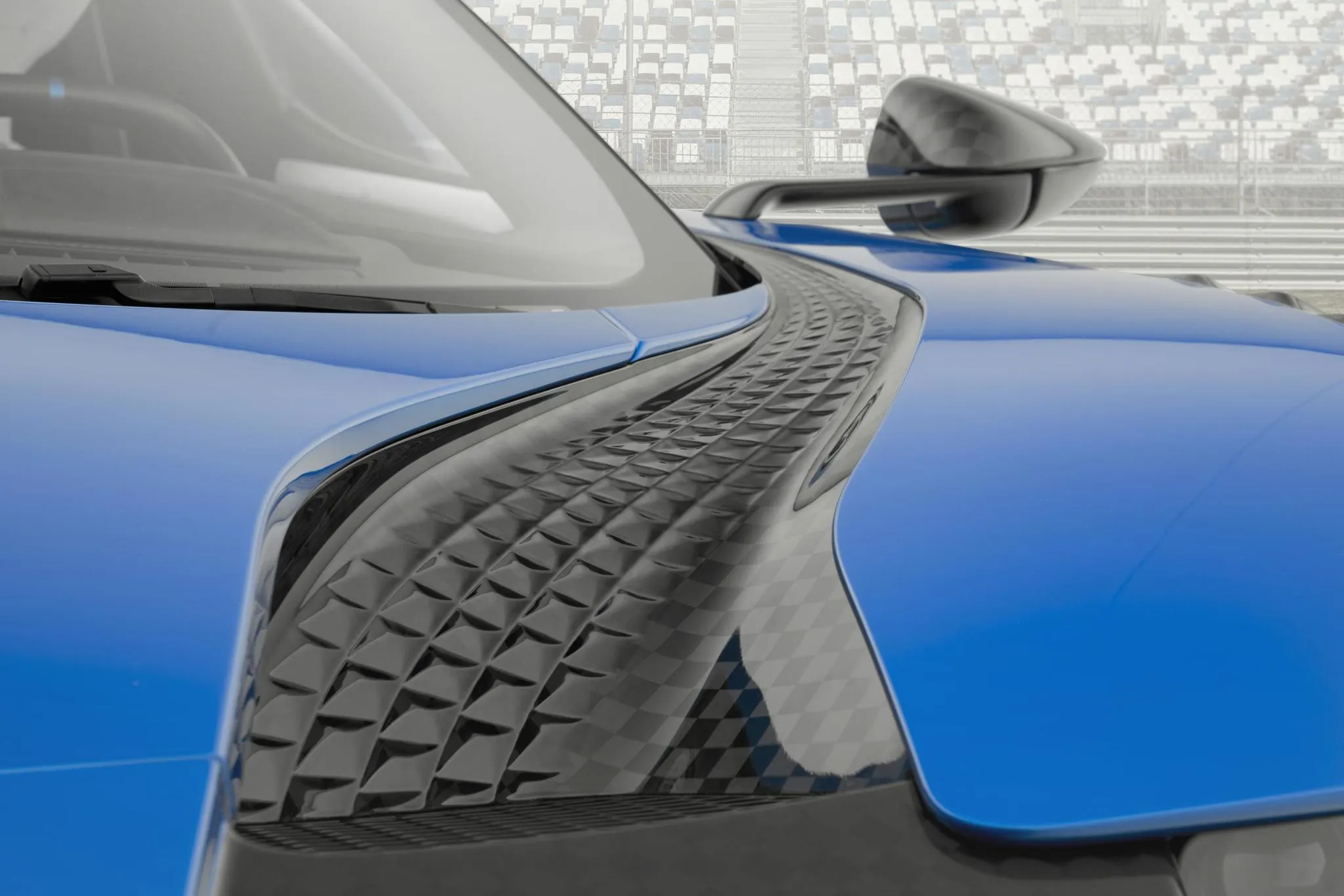
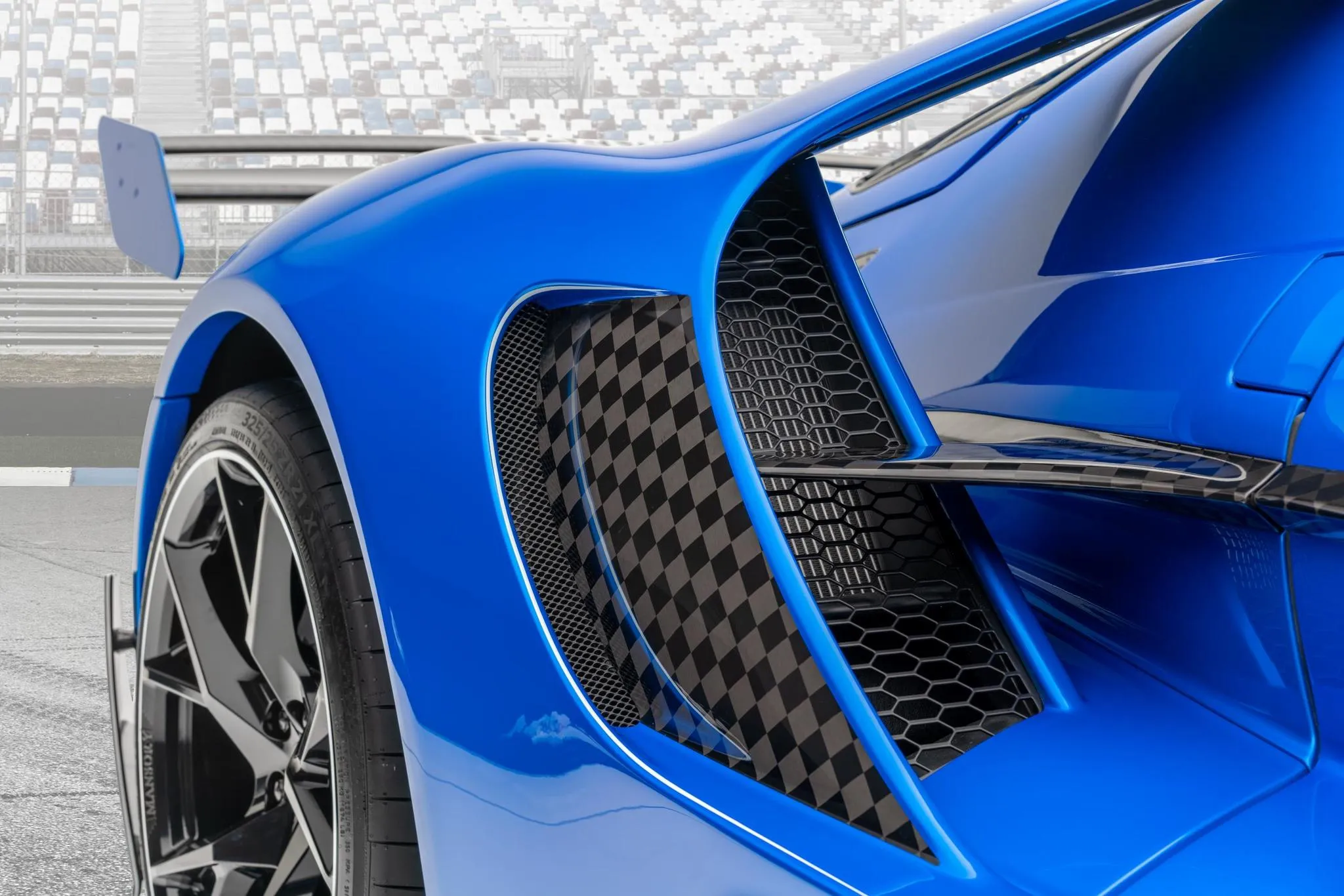


Mansory Carbon Fiber Body kit set for Ford GT


Le Mansory Ford GT — three cars, three decades, three commissions
The second-generation Ford GT (2017–2022) was already a defined collector chassis before Mansory touched it: 3.5-litre EcoBoost V6 twin-turbo derived from the GTE Le Mans programme, 647 hp / 550 lb-ft, full carbon fibre monocoque structure, total production capped at roughly 1,350 units worldwide across the entire run, application-only buyer process. Le Mansory — the 30th anniversary programme launched in 2020 — used the Ford GT as its base for the most restrained tier of the anniversary line: three cars, one per decade of the workshop's history. Each Le Mansory Ford GT is a complete carbon body conversion built to the buyer's specification, with the V6 lifted from the factory 647 hp to 700 hp / 620 lb-ft. There are exactly three of these in the world.
What the build covers
Le Mansory replaces the donor's structural carbon panels with Mansory-spec carbon panels — the GT's underlying carbon-fibre monocoque is preserved, but every visible body section is re-built. The build list is per-car and is finalised with the buyer at commissioning. Common to all three commissions:
- Complete carbon fibre body conversion — front clip, doors, side panels, rear quarter panels and rear deck all replaced with Mansory-spec carbon
- Custom LED headlights — bespoke optic assemblies designed for the Le Mansory front clip
- Redesigned front-end aerodynamics — new splitter, canards and lower intake geometry
- Bespoke bodywork — owner-specified details on rear wing geometry, side intake design, exhaust exit position
- Engine recalibration — 3.5 EcoBoost V6 lifted to 700 hp / 620 lb-ft from the factory 647 hp / 550 lb-ft
- Full Mansory cabin trim — bespoke leather, carbon trim and embroidered Le Mansory lettering
The donor's underlying mechanical package — the seven-speed Getrag dual-clutch gearbox, the pushrod suspension, the carbon-ceramic Brembo brakes — is preserved in OEM specification. The 700 hp tune is calibrated within the EcoBoost V6's stock long-block; no internal engine work is part of the Le Mansory programme.
Sister Mansory anniversary builds
Le Mansory was a workshop-wide programme in 2020. Other anniversary builds in our catalogue: the Aston Martin DB9 Curus as part of the British anniversary tier, and the Lamborghini and Bentley anniversary commissions referenced on the Hodoor Mansory blog. For the Ford GT specifically there is no sister Mansory programme — this is the only carbon body kit Mansory has ever released for the chassis.
Why this is a commission, not a catalogue kit
Most Mansory programmes are catalogue items: the workshop produces a kit, ships it on lead time, and any owner of the matching donor chassis can order one. Le Mansory Ford GT is the opposite. The total build count was set at three at launch, the cars were spoken-for in the first weeks of the announcement, and the carbon panels for each were laid up against that buyer's specification rather than against a published kit drawing. There are no spare parts in stock; there is no "buy it later" path. If a fourth Ford GT owner asks Mansory for the same build today, the workshop's answer is a per-VIN custom commission outside the Le Mansory programme — which falls under the broader Custom Design & Build service rather than the standard Mansory catalogue.
Where the three cars are — there is no shipping map
For every other build on the Hodoor Mansory site, this section is a freight-and-corridors map. For Le Mansory Ford GT it is not. Three cars exist in total. Their owners are private collectors. The cars themselves move between collector garages and concours events on a private-logistics basis rather than on a standard freight booking. We do not publish the locations of individual Le Mansory GTs. What we can say: the second-generation Ford GT donor itself was sold predominantly into the United States (the application process was US-led) and into a small number of European and Gulf collector hands, and the same geographic distribution shaped where the three Le Mansory commissions landed.
If you own a second-generation Ford GT
The Le Mansory programme itself is closed; the three commission slots are filled. For Ford GT owners who want a Mansory-spec carbon refinement on the donor without the full Le Mansory build, the workshop accepts custom commissions on a per-VIN basis. The starting point is your VIN, the build target (carbon refinement vs full body conversion vs engine work alone), and a delivery facility. Email [email protected] or WhatsApp +44 7488 818747 with the VIN and the brief; we will route the conversation to the workshop's custom-build desk and quote per-project. Lead times are six months and up — these are one-off builds rather than catalogue lead times.
Geographic spread of Ford GT commissions
Order traffic for the Mansory Ford GT clusters around a handful of markets in 2026. Asia-Pacific volume runs through Hong Kong and Singapore, where forged-wheel sets are usually configured alongside the body kit. African footprint covers Egypt and Nigeria, with periodic Egyptian deliveries via South Africa. In the Gulf, dealers in Bahrain and the United Arab Emirates commission this kit alongside other Mansory programmes. Every Ford GT kit leaves with tracked, insured logistics and customs documents prepared for the destination.
Mansory cross-references for cross-shoppers
- Bentley Bentayga — a parallel programme on the same Mansory shelf.
- Ferrari F8 Tributo — a parallel programme on the same Mansory shelf.
- Mercedes G-class W463A — a parallel programme on the same Mansory shelf.
FAQ
Can I order a Le Mansory Ford GT today?
No. The programme was capped at three cars at launch in 2020 and all three slots were taken. Mansory has not announced a continuation programme on the Ford GT chassis. Custom commissions on a Ford GT donor are accepted on a per-VIN basis but they are not branded "Le Mansory" and they do not carry the anniversary numbering.
Does the 700 hp tune work on a stock Ford GT, separately from the body work?
The Le Mansory tune was calibrated for the cars in the programme. Mansory's standard position on the Ford GT is that engine work is a per-VIN commission rather than a published power module — there is no off-the-shelf PowerBox for the 3.5 EcoBoost V6 in this chassis. Talk to the custom desk if you want to scope this for a specific donor.
Are body parts available individually?
No. The Le Mansory carbon panels were laid up to each commission's specification and there is no stocking of individual SKUs. Replacement panels for the three existing cars are handled through Mansory's after-sales channel directly with the owners.
Does the kit fit the first-generation Ford GT (2005–2006)?
No. The first-generation Ford GT (5.4 V8 supercharged, retro-styled body) is a different chassis with different body geometry. Le Mansory was developed against the second-generation carbon-monocoque GT only.
Why does Hodoor list a build that is no longer orderable?
Because the second-generation Ford GT is in active collector circulation, and owners who want context on what Mansory has done to the chassis use this page to start the custom-commission conversation. The product page acts as the entry point to the per-VIN custom desk for Ford GT owners.
What does "one car per decade" mean?
Mansory's 30th anniversary fell in 2020. Le Mansory was the anniversary programme; for the Ford GT specifically, the count was set at three cars to mark the workshop's three decades. The count is not a marketing construction — it is the actual production cap on the carbon panels for the GT chassis.